The healthcare industry in India is rapidly moving towards digital transformation. Hospitals, clinics, diagnostic centres, and healthcare professionals are increasingly adopting technology to improve patient care, simplify daily operations, and manage medical information more efficiently.
Traditional paperwork, manual billing, disconnected departments, and scattered patient records can create operational challenges for healthcare providers. A modern Hospital Management System (HMS) helps address these challenges by bringing essential hospital operations together on a centralized digital platform.
At DoMyCheckup, our vision is to support healthcare providers with modern digital solutions that simplify healthcare management and help build a more connected healthcare ecosystem.
What Is Hospital Management Software?
Hospital Management Software is a digital solution designed to manage the administrative, clinical, and operational activities of hospitals and clinics.
Depending on the system and its configuration, it can integrate multiple departments and workflows into one platform, reducing repetitive manual work and improving coordination between healthcare teams.
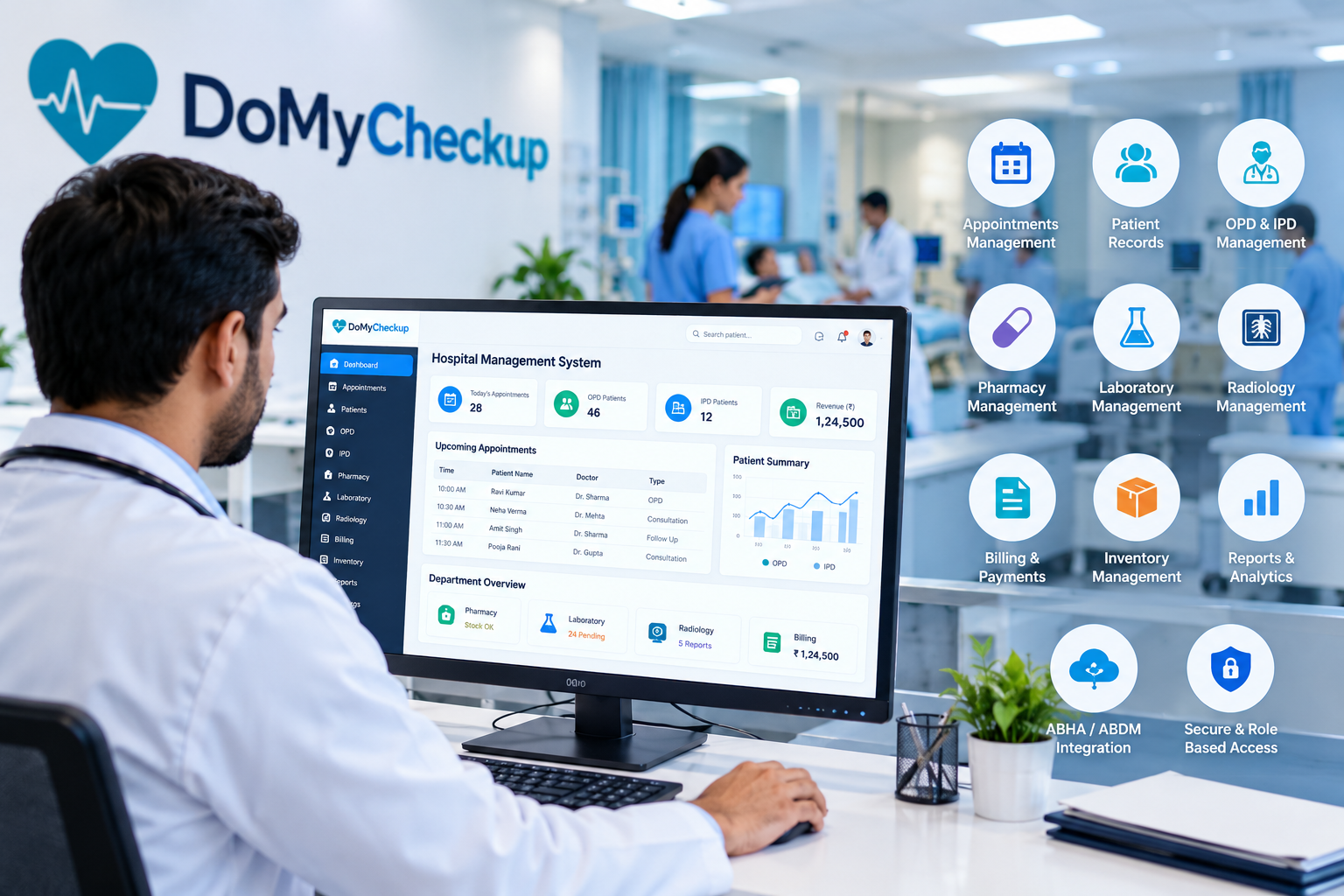
Key features may include:
Online doctor appointments and scheduling
Outpatient Department (OPD) management
Inpatient Department (IPD) and bed management
Electronic Medical Records (EMR)
Patient registration and medical history
Pharmacy and prescription management
Pathology and laboratory management
Radiology and diagnostic workflows
Billing, payments, and financial reports
Inventory and medical stock management
Discharge summaries and clinical documentation
User roles, permissions, and operational reports
With centralized information, authorized staff can access relevant records according to their roles and permissions.
7 Benefits of Hospital Management Software
1. Simplified Appointment Management
Managing appointments manually can result in scheduling conflicts, long waiting times, and additional administrative work.
Digital appointment management helps hospitals and clinics organize doctor availability, consultation fees, booking slots, and patient appointments more efficiently. Online booking can also make it easier for patients to find suitable consultation times.
2. Better Patient Record Management
Patient information is essential for informed clinical decisions and continuity of care.
Electronic Medical Records help healthcare providers maintain patient details, medical histories, prescriptions, diagnoses, and relevant clinical documentation in a structured digital format.
Appropriate access controls and security measures are important to protect confidential patient information.
3. Streamlined Billing and Payments
Manual billing can increase administrative workload and create opportunities for calculation errors.
Hospital billing software can help manage consultation charges, diagnostic services, pharmacy transactions, inpatient charges, receipts, and outstanding balances. Integrated billing workflows can improve financial visibility and simplify daily reconciliation.
4. Improved Coordination Between Departments
Hospitals often operate several departments, including OPD, IPD, pharmacy, pathology, radiology, nursing, emergency services, and billing.
A centralized HMS can connect these departments through shared workflows, helping authorized staff access relevant information and reducing unnecessary duplication of data.
5. Efficient Pharmacy and Inventory Management
Pharmacy and inventory management require accurate information about medicines, batches, expiry dates, stock levels, and transactions.
A suitable system can help track inventory movements, monitor stock availability, identify products approaching expiry, and maintain more organized purchasing and dispensing records.
6. More Organized Laboratory and Diagnostic Workflows
Laboratory and diagnostic departments handle multiple steps, from test ordering and sample collection to result entry and report generation.
Digital workflows can help organize these activities, improve traceability, and make diagnostic information available to authorized healthcare professionals.
7. Support for Digital Healthcare and ABDM
India's Ayushman Bharat Digital Mission (ABDM) aims to support an interoperable digital health ecosystem.
ABDM-related capabilities may include ABHA integration, health information exchange, and appropriate linking or sharing of health records, subject to applicable standards, permissions, consent requirements, and implementation readiness.
Healthcare providers should evaluate whether their software supports the specific ABDM integrations and workflows required by their organization. An ABDM-related feature should not be assumed to mean that every certification, integration, or production approval is automatically complete.
What Is the Role of ABHA and ABDM in Digital Healthcare?
The Ayushman Bharat Digital Mission is intended to enable a more connected digital healthcare ecosystem in India.
The Ayushman Bharat Health Account (ABHA) provides an identity mechanism for individuals participating in the digital health ecosystem. With appropriate consent and compatible systems, digital health information can be linked and exchanged through supported workflows.
For hospitals and clinics, relevant digital health capabilities can help improve record accessibility, support continuity of care, and reduce reliance on disconnected information systems.
Healthcare organizations should adopt secure systems that follow applicable ABDM specifications and protect patient privacy.
Why Choose DoMyCheckup?
DoMyCheckup focuses on helping healthcare providers manage their operations through digital healthcare solutions.
Our healthcare technology vision brings together patient-facing services and hospital management capabilities to support more organized and connected workflows.
With a focus on modern healthcare operations, DoMyCheckup supports the digital management of areas such as:
Doctor appointments and patient registration
Hospital Management Software (HMS)
Electronic Medical Records (EMR)
OPD and IPD workflows
Pharmacy, pathology, and diagnostic operations
Billing, inventory, and reporting
Digital healthcare and ABHA/ABDM-related workflows
The right solution depends on the size of the healthcare facility, its departments, operational requirements, and integration needs.
How to Choose the Right Hospital Management System
Before selecting hospital management software, healthcare providers should consider the following factors:
Scalability: Can the system support additional doctors, departments, branches, or hospitals as the organization grows?
Ease of use: Can receptionists, doctors, nurses, pharmacists, and administrative staff use the relevant features efficiently?
Integration: Does the software support the required laboratory, pharmacy, billing, diagnostic, and digital health integrations?
Security: Does it provide appropriate user permissions, access controls, audit trails, backups, and safeguards for sensitive medical information?
Reporting: Can management review relevant operational, financial, and departmental reports?
Support and implementation: Is training, technical assistance, and ongoing maintenance available?
Compliance readiness: Does the solution meet the applicable legal, regulatory, privacy, and technical requirements for the intended deployment?
Evaluating these factors can help healthcare organizations select a system that meets their current needs and supports future growth.
The Future of Digital Healthcare in India
Digital healthcare is evolving beyond basic computerization. Connected medical records, online consultations, automated administrative workflows, diagnostic integrations, and interoperable health information systems are becoming increasingly important.
As healthcare organizations adopt these technologies, the emphasis must remain on patient safety, reliable information, privacy, security, and practical usability.
A well-implemented Hospital Management System can help healthcare teams spend less time managing fragmented administrative processes and more time supporting patients.
Conclusion
Hospital Management Software is becoming an important part of modern healthcare infrastructure. By bringing appointments, medical records, billing, pharmacy, diagnostics, and administrative workflows together, it can help hospitals and clinics improve coordination and manage their operations more effectively.
DoMyCheckup aims to support this transformation through digital healthcare and hospital management solutions designed around the needs of healthcare providers.
Ready to modernize your healthcare operations?
Explore DoMyCheckup to learn more about our healthcare technology solutions for hospitals, clinics, and medical professionals.
Suggested CTA button: Explore DoMyCheckup | Contact Our Team
Frequently Asked Questions
What is Hospital Management Software?
Hospital Management Software is a digital platform that helps hospitals and clinics manage appointments, patient records, billing, pharmacy, diagnostics, inventory, and other operational workflows.
Is HMS useful for small clinics?
Yes. A suitably configured HMS can help small clinics organize appointments, maintain patient records, manage consultations, and simplify billing. The features required depend on the clinic's size and services.
What is the difference between HMS and EMR?
HMS generally manages a broader range of hospital operations, including administration, billing, departments, and inventory. EMR focuses primarily on digital clinical records and patient medical information. An HMS may include EMR functionality.
What is ABHA?
ABHA stands for Ayushman Bharat Health Account. It provides an identity mechanism within India's digital health ecosystem and supports relevant digital health workflows when used with compatible systems.
Can hospital software manage OPD and IPD?
A suitably configured system can support both OPD and IPD workflows, including patient registration, consultations, inpatient management, billing, and discharge documentation.
How can I learn more about DoMyCheckup?
Visit the DoMyCheckup website or contact the team to discuss your healthcare facility's requirements and the available software capabilities.
Digital Healthcare
Back to All Blogs
How Hospital Management Software Is Transforming Healthcare in India
18 Oct 2026
Discover how DoMyCheckup helps hospitals and clinics streamline appointments, patient records, billing, pharmacy, laboratory management, and digital healthcare with modern Hospital Management Software (HMS).
Back to All Blogs